From Data to Drug Candidate
One platform. Target discovery and molecular discovery under one roof.
From Static Correlation to Dynamic Simulation
Beyond the black box of AI and the statistical correlations of conventional bioinformatics. MObyDiCK runs explainable simulations that prove causality.
Traditional AI & DEG analysis
- —Relies on static network snapshots
- —Identifies statistical correlation, not biological causation
- —Suffers from the Black Box problem, unable to explain how or why
MObyDiCK Cellular Digital Twin (CDT) + AI
The CDT is a dynamic network model of the cell.
- —Models dynamic regulatory networks
- —Simulates live cellular trajectories and state transitions
- —Analyzes causality to identify master regulatory switches
- —Delivers fully explainable Mechanism of Action (MoA)
3-Step Simulation Engine
Pseudotime analysis
Maps the biological timeline of cell-state transitions
Network model inference
AI builds the causal gene-regulatory backbone
Network control simulation
In silico perturbation finds the optimal control kernel
Simulate the cell. Find the switch.
Run the network model, and the cell rolls downhill like a ball, settling into stable states called attractors. Each attractor represents a specific cell state, healthy here, diseased there.
From that landscape, we perturb each node to identify the few that can shift a cell out of the disease state. And we can see how they change the cell state.
Predicted in silico. Validated at the bench.
MObyDiCK identifies TFF3 as a potential target for overcoming resistance.
In KRAS G12C-mutant H1792 NSCLC cells, targeting TFF3 with the inhibitor AMPC alongside sotorasib markedly reduced cell viability and colony formation compared with either treatment alone.
From that target, we turn to its protein. And that protein is where ERWIN begins.
ERWIN: Physics-Aware Generative AI for Drug Design
Physics-aware AI platform for structure preparation, molecular docking, and free energy perturbation (FEP)
- [ physics-based ]
- +Obeys physical and chemical law
- +No clashes, no chirality errors
- +Reliable on novel pockets
- −But slow and low pose accuracy
- [ AI-based ]
- +Dramatically fast
- +High pose accuracy
- +Creative poses
- −But breaks outside its training data
Physics is injected as a condition into the generative model.
Reliable on pockets no model has seen.
Seven stages.
From raw structure to ΔΔG. No hand-offs, no gaps, no silent errors.
Protein preparation
Missing atoms rebuilt, protonation resolved, H-bond network optimized
Ligand preparation
Protonation states, tautomers, and 3D conformers enumerated
Binding site
Pocket detection and search-space definition
Docking
Pose sampling, scoring, and ranking by affinity
Interactions
Contact detection, 2D and 3D visualization, interaction fingerprints
MD refinement
Solvated MD, MM-PBSA, binding stability assessment
FEP · ΔΔG
Alchemical transformation and free-energy calculation
Known-answer test
All FDA-approved drugs screened entirely within ERWIN, from preparation to docking, with no external tools or manual intervention.
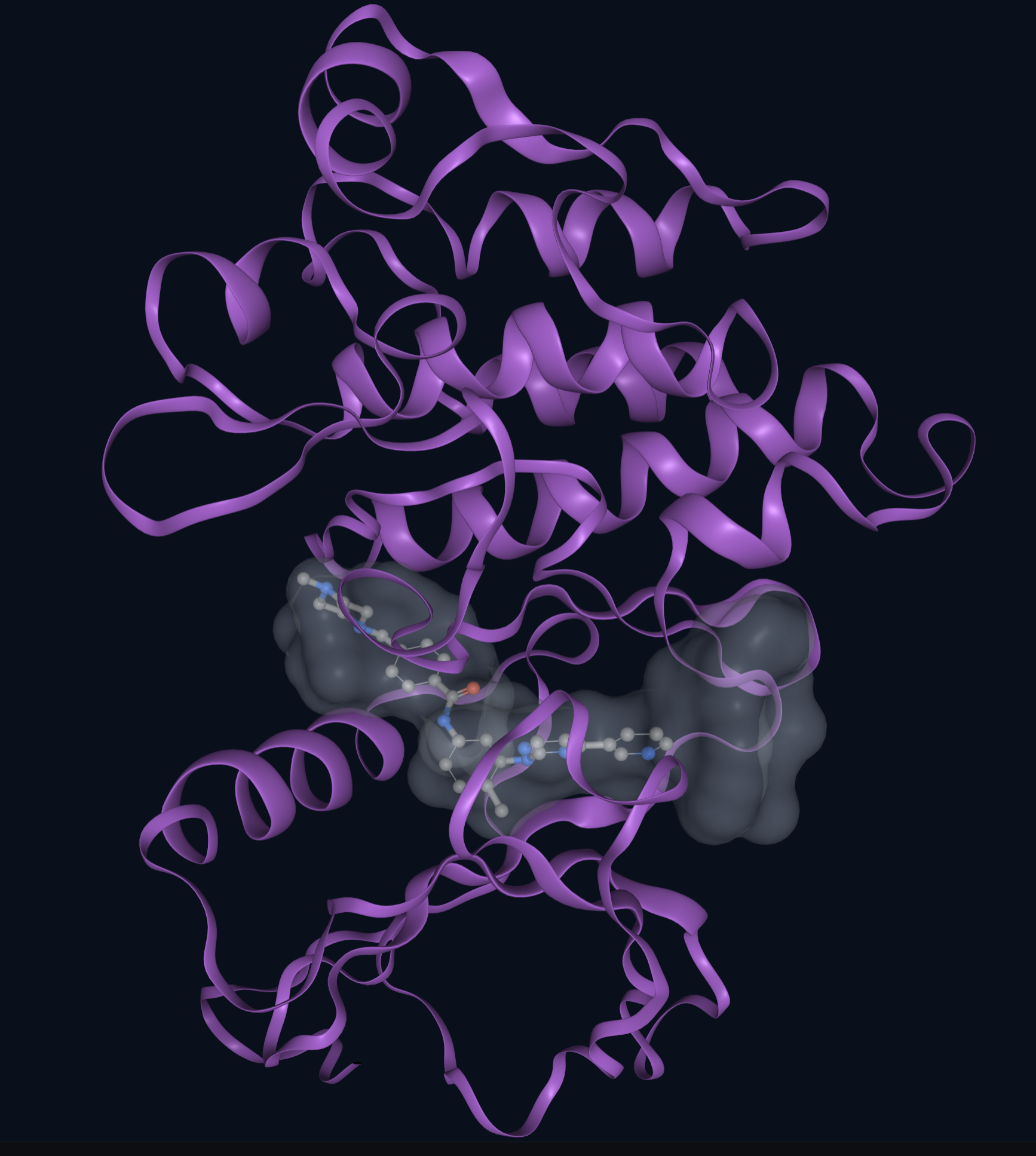
"Given only the target, ERWIN put the approved drug at #1, and its two successors at #2 and #3."
From Data to Drug Candidate — One Platform
Others start where the target is already known.
We start where there is only data, and still finish with a molecule.
MObyDiCK identifies what to target before a compound exists.
By pinpointing key targets and their mechanisms, MObyDiCK enables validation experiments to be designed before compound development begins.
First-in-class targets demand more than learned patterns.
Purely AI-based models can struggle to extrapolate beyond what they have seen in training, leading to lower pose accuracy on truly novel targets. ERWIN combines AI with physical chemistry, giving it a stronger foundation for predicting binding poses even in first-in-class targets.
One integrated discovery workflow.
From target discovery and mechanism validation to virtual screening and compound optimization, every stage is connected within a single development ecosystem. No vendor hand-offs, no fragmented data, and no loss of scientific context. This seamless integration accelerates the path from biological insight to novel drug candidates.
Not a slide. A running system.
This platform ships as a browser-based workbenches. Every stage in the sidebar is a job you can run, inspect, and rerun.
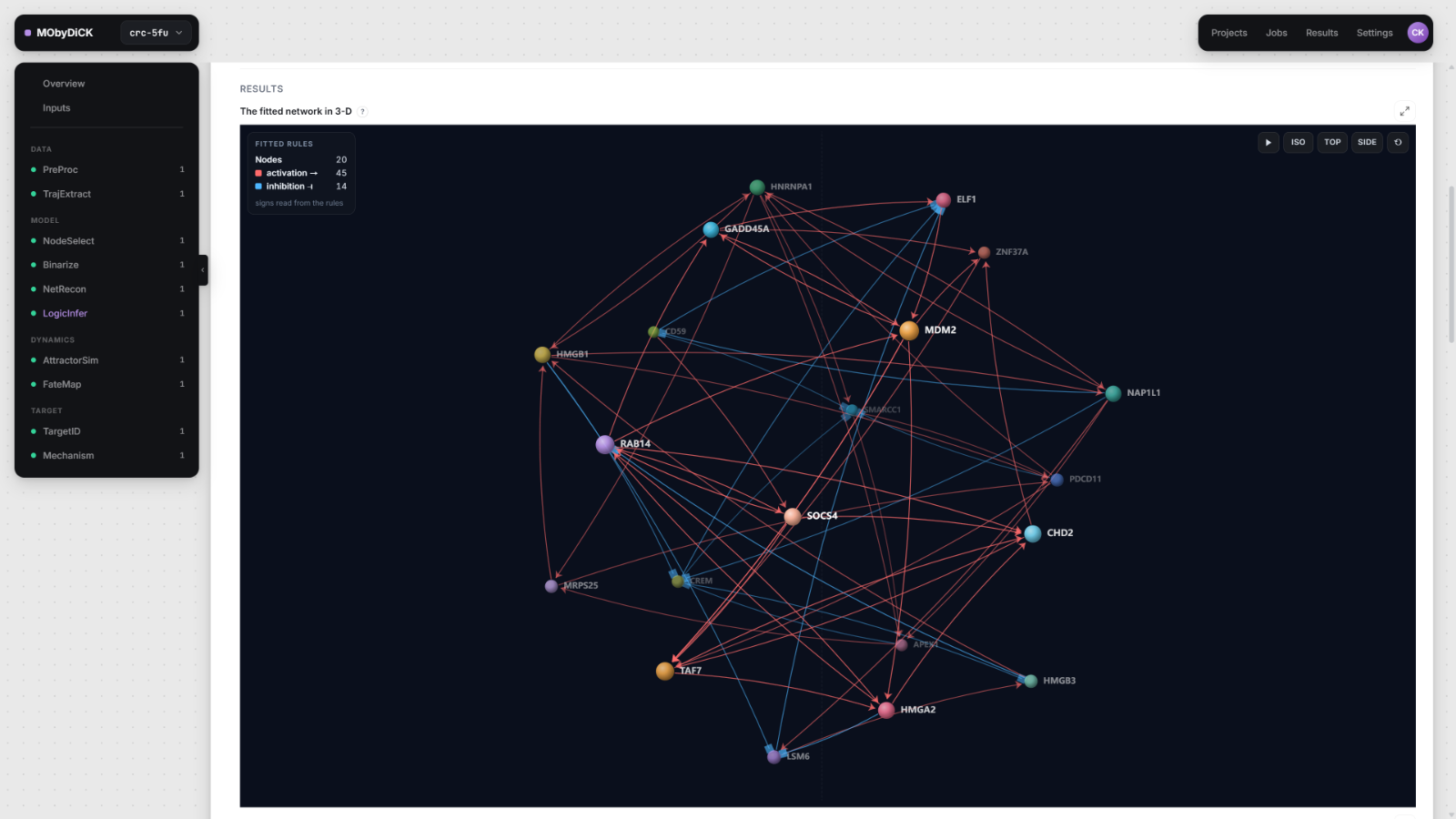
The fitted network in 3-D
After extracting the cell trajectory and reconstructing the gene regulatory network, LogicInfer learns the Boolean rules governing each node. Here, the model connects 20 genes through 45 activating and 14 inhibiting interactions, with each interaction derived directly from the fitted rules. This network then serves as the foundation for downstream analyses, including AttractorSim, FateMap, and TargetID.
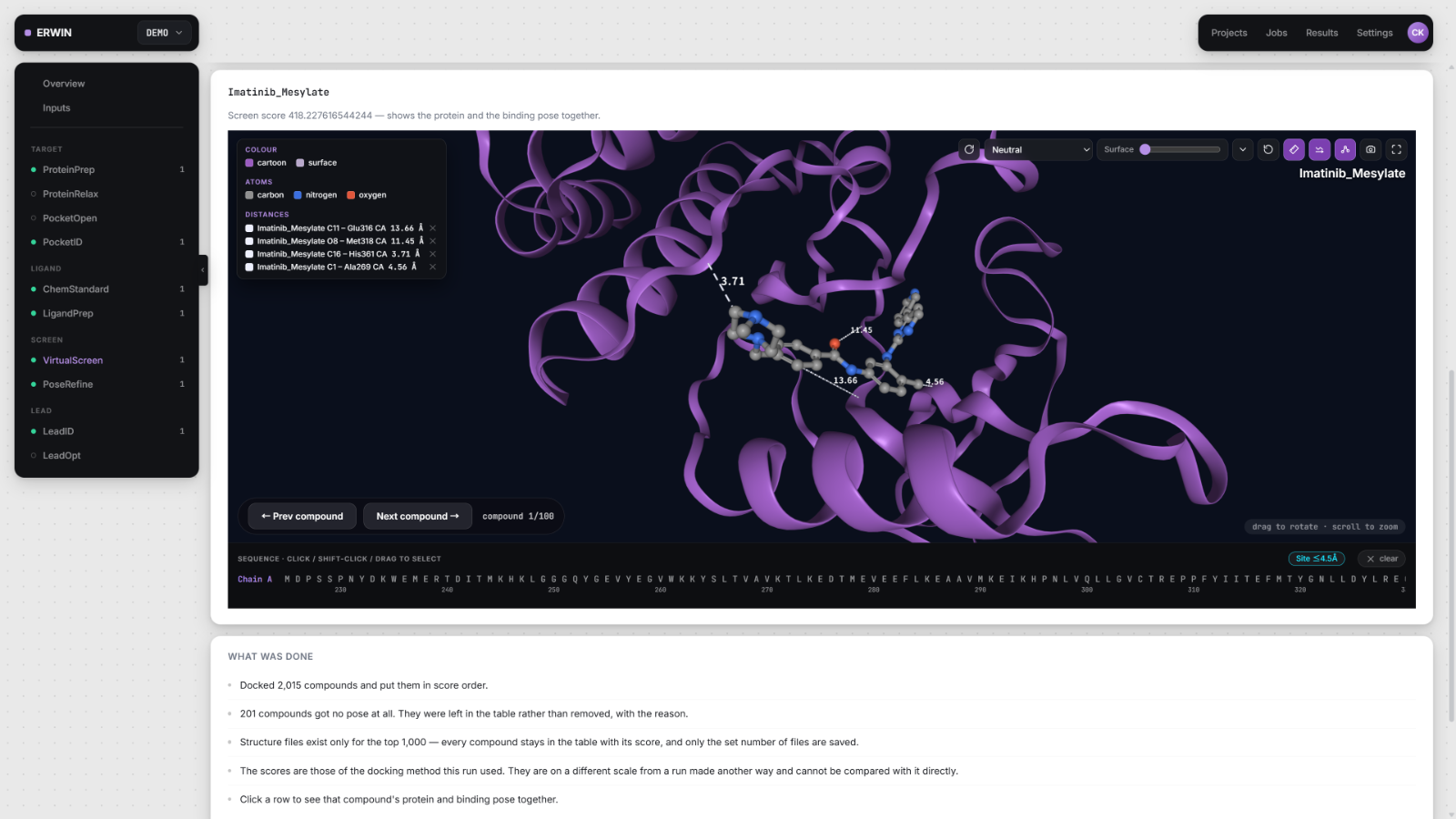
The pose, with the protein
Here, the known-answer screen shows imatinib mesylate ranked first, with a screen score of 418.2. Its predicted binding pose is displayed directly inside the BCR-ABL binding site, while ERWIN measures the distances to key residues including Glu316, Met318, His361, and Ala269 in real time. The sequence track below highlights residues within 4.5 Å of the ligand, providing a clear view of how the compound interacts with the protein.